Landscaping Rocks Near Playground Equipment: Risks & Safety Tips | California
By Anne Smith | Certified Playground Safety Inspector

It’s not uncommon to see landscaping rocks placed near playground equipment in parks, schools, and HOA communities. It can look clean, intentional, and even well thought out.
From an inspection standpoint, though, it raises consistent concerns.
The Problem with Rocks Near Playgrounds
Children don’t see landscaping the way adults do.
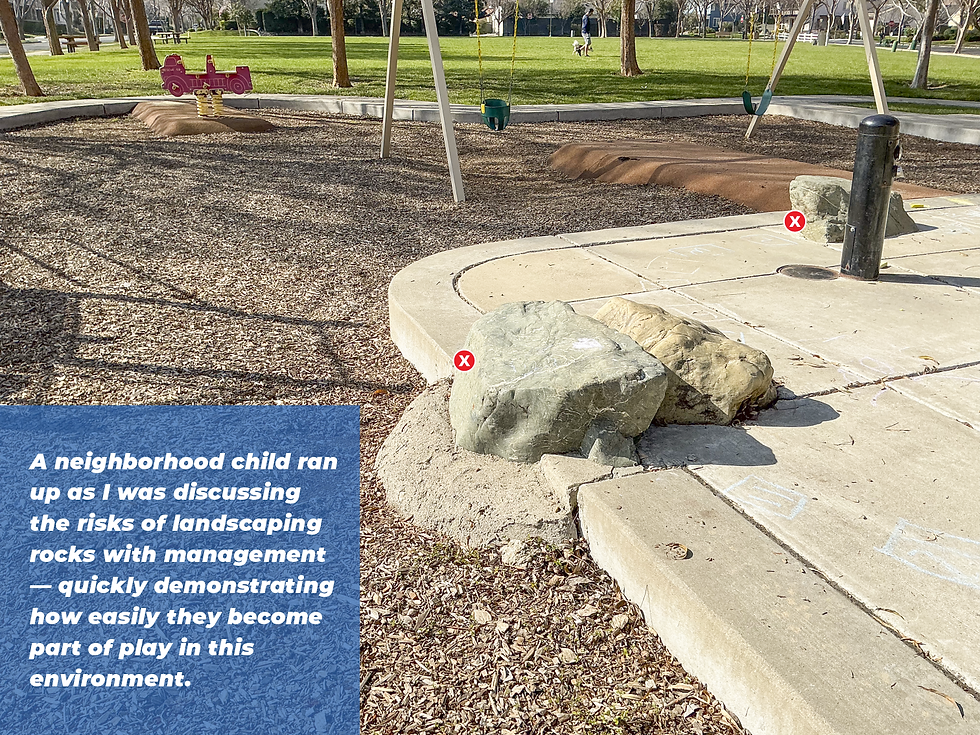
If there’s a rock nearby, they will climb it. They will jump from it. They will incorporate it into their play—whether it was intended or not.
I’ve seen it countless times. My own nephew is proof: if there’s a rock, it instantly becomes part of the playground.
That’s where the issue begins.
Playground equipment is designed with specific use zones and surfacing requirements in mind. Introducing hard, climbable materials like landscaping rocks near those areas creates additional opportunities for falls onto surfaces not intended to reduce impact.
Why Surfacing Matters
Falls are one of the most common causes of playground injuries. Protective surfacing is intended to help reduce the severity of those impacts.
However, that protection only works where it is present.
If a child lands on a hard surface—such as concrete, compacted ground, or rock—the protective benefit of surfacing is no longer there. Serious head injuries can occur from a single fall.
A Practical Approach
From an inspection and risk management perspective, the recommendation is straightforward:
Keep landscaping rocks well away from playground equipment, entry points, and active play areas.
Creating sufficient distance helps reduce the likelihood that rocks will be used as additional climbing or jumping elements. What that distance looks like will vary by site—but the goal is separation.
If that separation cannot be achieved, the better approach is to avoid placing rocks in the area altogether.
If landscaping rocks are still incorporated near a playground, then additional precautions become critical. Providing appropriate protective surfacing in all directions around those elements, along with maintaining proper use zones for adjacent equipment, can help reduce potential impact-related concerns.
Liability Considerations
From a management perspective, placing hard, climbable materials near playground equipment can create unnecessary exposure.
If an injury occurs and the surrounding surfaces do not align with how the space is used in practice, questions may arise about whether reasonable care was taken in the layout and maintenance of the area.
Regular inspection and thoughtful design decisions play an important role in reducing those risks.
Design with Behavior in Mind
Playgrounds are not static environments. They are dynamic spaces shaped by how children choose to use them.
Kids will test boundaries. They will create their own paths and challenges. That’s part of how they learn.
Designing and maintaining playgrounds with that behavior in mind—rather than ideal use—leads to better outcomes for both users and operators.
Playgrounds are meant to support development, exploration, and social interaction. That includes an element of risk.
The goal is not to eliminate that risk—but to manage hazards that can be reasonably addressed through layout, maintenance, and inspection.
Sometimes, that starts with something as simple as where a rock is placed.
Frequently Asked Questions
Are landscaping rocks allowed near playground equipment?
Landscaping rocks are not prohibited, but placing them near playground equipment is not recommended. Children often use nearby elements as part of play, which can increase the risk of falls onto hard surfaces.
How far should rocks be from playground equipment?
There is no single prescribed distance. A practical approach is to keep rocks well away from active play areas, entry points, and equipment. If they are placed nearby, protective surfacing should be considered.
Why is protective surfacing important on playgrounds?
Protective surfacing is designed to reduce the severity of head injuries from falls. Without it, hard surfaces like concrete or rock can significantly increase the risk of serious injury.
Can landscaping features become playground hazards?
Yes. Features like rocks, borders, and walls may be used by children in unintended ways, such as climbing or jumping, which can introduce additional risk if not properly planned.